
Our history
The Italian Society of San Antonio, since 1890
Founded by Italian immigrants to help one another find their footing, the Society is the longest continuously operating Italian American society in the United States.
Key dates
- 1890The Società Italiana Cristoforo Colombo is chartered in Texas
- 1926The congregation of San Francesco di Paola is organized
- 1927The Church of San Francesco di Paola is dedicated
- 1928The Italian Hall opens, the first in Texas
- 1957The Society gives the city a Columbus statue
- 1992The church becomes a Texas Historic Landmark
- 2023A statue of San Francesco di Paola is dedicated
I.
A flight to economic opportunity
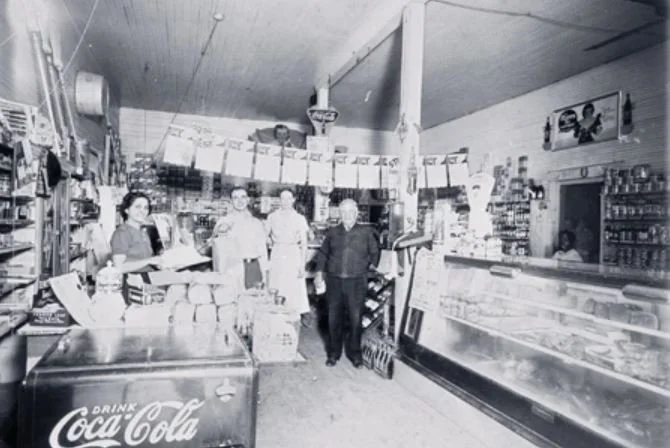
Harsh conditions in southern Italy, where most of San Antonio's Italian immigrants came from, pushed them here as part of a great wave of immigration from southern and eastern Europe between 1880 and 1930.
About four and a half million Italians are estimated to have entered the United States in those years.
Near the end of the nineteenth century, when San Antonio had just 37,673 residents, a small group of Italians arrived in the Alamo City. Most were immigrants, so for their mutual benefit they formed a fraternal organization to help Italian families adapt to a new language and a new way of life.
Little did they know that organization would become the longest continuously running Italian organization in the United States.
II.
The founding years
The Società Italiana Cristoforo Colombo was chartered under the laws of Texas in May 1890. Ever since, the Society has kept to its mission of carrying on Italian culture, family values and heritage in San Antonio.
The founders named the Society after Cristoforo Colombo, the explorer from the Republic of Genoa who made four voyages across the Atlantic. Sponsored by the Catholic Monarchs of Spain, his expeditions were the first known European contact with the Caribbean and Central and South America, and opened the way for European exploration and colonization of the Americas.
The first signers and meetings
The application for the charter, dated April 30, 1890, was signed by:
- Carlo A. Solaro
- Anthony Battaglia
- Marco Bargna
- Giacinto Garroni
J. Burda and Augusto Battaglia signed as witnesses, and the County Clerk of Bexar County issued the charter on May 13, 1890.
The Society's first meeting was held in the historic Veramendi Building, at the corner of Main Avenue and Veramendi Street. It later met on the second floor of a building occupied by the San Antonio Meat Company, and for a short time at the corner of West Commerce and South Presa streets.
III.
If you build it, they will come
In 1926, at the request of the city's Italian Catholics, diocesan officials invited the Reverend Saverio Vecchio to preach a mission. From it, the congregation of San Francesco di Paola was organized.
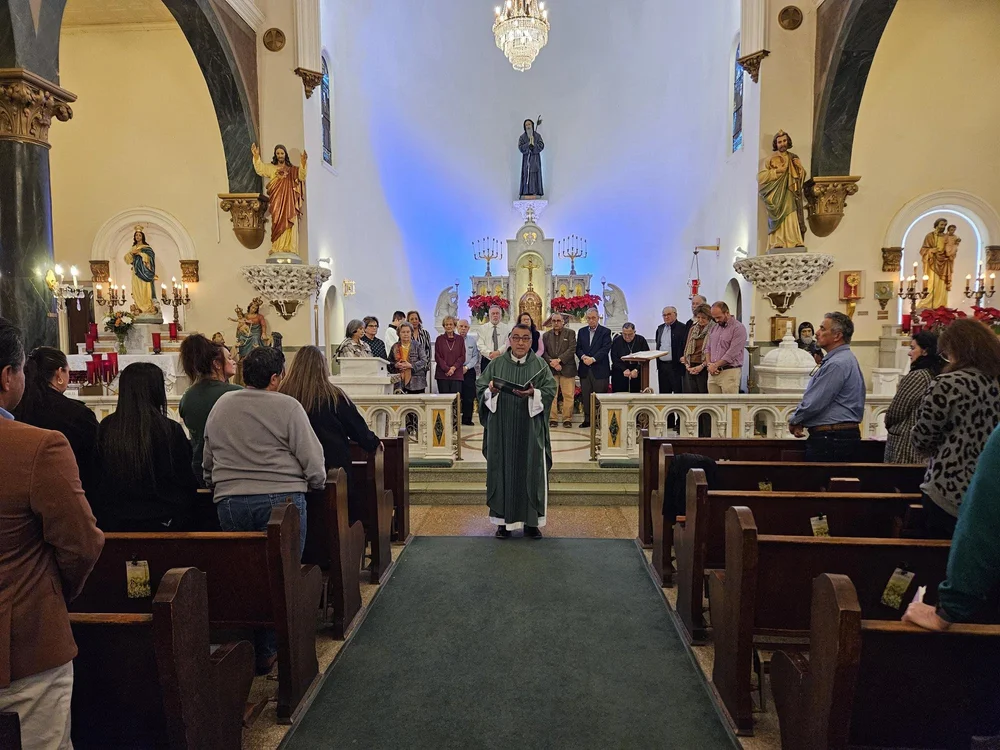
The next year the Italian community built the Church of San Francesco di Paola, with members taking out a $40,000 mortgage to pay for it. Designed by Richard Vanderstratten and built by Luigi L. Guido and Vincenzo Falbo, the Romanesque church, with its decorative stonework, round-arched stained-glass windows and spire, was dedicated on May 1, 1927, by Archbishop A. J. Drossaerts. It was recorded as a Texas Historic Landmark in 1992.
CHARITASSaint Francis of Paola is often shown with a shield bearing the word Charitas. By tradition, while the saint was deep in contemplation, the Archangel Michael appeared holding a shield that shone like the sun, with that single word written on it in gold. The angel gave him the shield as the coat of arms for his order:
“Francisce, haec erunt insignia tui Ordinis.”
Embodying that legacy of charity, members of the Society played leading roles in planning, funding and building the church. Charity remains at the heart of the Italian Society today.
IV.
The Italian Hall and the path forward
In the years that followed, the Society built its permanent home, the Italian Hall, steps from the church. When it opened in 1928, it was the first Italian Hall in Texas.
The Hall and the church both face Piazza Italia Park on Columbus Square. On October 12, 1957, the Society gave the City of San Antonio an Italian-made statue of Christopher Columbus. It stood in Columbus Park until 2020, when it was removed amid protests.
The Italian Society rebukes the subjugation of all people, and has taken concrete steps so the organization can thrive in the years to come. It has welcomed Sunday Mass in Spanish, changed from a fraternal organization to a co-ed Society, elected its first woman president, and replaced the Columbus statue with one of San Francesco di Paola. Dedicated on September 9, 2023, it is only the second religious statue on public land in the city.
V.
Steadfast mission, unwavering commitment
Since its founding, the Society has carried on Italian culture, family values and heritage in San Antonio through three objectives set out in its constitution:
- Charitable, educational, religious, social welfare and public relief work
- Social and intellectual dialogue among members and their families
- Strong community relations
As San Antonio's Italians prospered, they took on leadership roles in the city's social, political and economic life. The Society, in turn, extended its work to the wider community:
- Donating an entire room at Santa Rosa Children's Hospital
- Starting Italian language classes open to anyone in the San Antonio area
- Providing shoes each year to children at St. Peter's and St. Joseph's Children's Home
- Supporting the Carmelite Day Care Center and many other projects and organizations
The Society is also known for its members' countless hours making the pasta and homemade sauce for the spaghetti dinners served at the Italian Hall throughout the year.
After more than a century, members of the Italian Society remain proud of their heritage, and equally proud to be citizens of the United States and of San Antonio. To see more of this history, visit the Italian section at the Institute of Texan Cultures, where many artifacts are on permanent display.
Be part of the next chapter
Join the Society, or come to a dinner, a class or a celebration at the Italian Hall.